In the ever-evolving landscape where commerce and creativity intersect, few collaborations have captured the global imagination quite like the partnership between Japanese retail giant Uniqlo and the enigmatic artist known as Kaws. What began as a series of limited-edition T-shirts has blossomed into a full-fledged cultural phenomenon, redefining the very notion of accessibility in the art world under the ambitious banner of Art For All. This is not merely a marketing campaign; it is a carefully orchestrated movement that challenges the exclusivity of high art and democratizes aesthetic experience on an unprecedented scale.
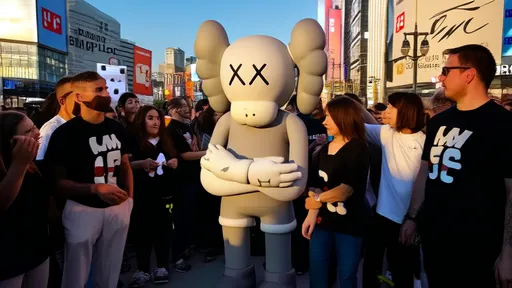
The story of Kaws, born Brian Donnelly, is itself a testament to this blurring of boundaries. Emerging from the skateboarding and graffiti subcultures of 1990s New York, Kaws developed a unique visual language. His signature motifs—the X-ed out eyes, the companionable yet melancholic Companion figure, and the skull-and-crossbones-inspired Chum—first gained notoriety through his subversive alterations of phone booth advertisements and billboards. This guerrilla approach laid the groundwork for his philosophy: art should exist in the public realm, not just within the hallowed halls of museums. His journey from the streets to prestigious galleries like the Brooklyn Museum and the Yuz Museum in Shanghai mirrors the trajectory of street art itself, from an act of rebellion to a respected, multi-million dollar segment of the contemporary art market.
Uniqlo, with its foundational philosophy of LifeWear—clothing that is simple, high-quality, and universal—proved to be the ideal corporate partner for Kaws's populist vision. The brand had already dabbled in art-world collaborations, most notably with the MOMA collection, but the Kaws partnership represented something different. It wasn't about placing a famous painting on a garment; it was about integrating a living artist's complete iconography into the very fabric of everyday life. The initial 2016 collection was a calculated experiment. The products were simple: cotton T-shirts, totes, and plush toys adorned with Kaws's instantly recognizable characters. The result was a retail frenzy. Lines snaked around city blocks, online stocks sold out in minutes, and the items became coveted objects on the resale market.
The success of that first drop signaled a seismic shift in consumer behavior. It demonstrated a burgeoning desire for products that offered more than just utility; they offered a connection to a narrative, a piece of a cultural conversation. Uniqlo and Kaws had tapped into a new paradigm where wearing a T-shirt was not just a matter of fashion, but a statement of affiliation with a particular artistic sensibility. This was fashion as a portable gallery, a means of personal curation. The collaboration transformed customers into patrons of the arts, allowing them to participate in Kaws's world for a fraction of the cost of an original artwork or even a limited-edition print.
Subsequent collections refined and expanded this concept. The partnership matured beyond simple graphic tees to include more complex apparel like hoodies, button-down shirts, and even children's clothing. Each new release was treated as an artistic event, with meticulously designed lookbooks and global launch campaigns that rivaled those for high-fashion collections. The 2019 collection, which coincided with a major Kaws exhibition, achieved a near-mythical status. The image of shoppers in China and the United States alike rushing into stores, scrambling to get their hands on the merchandise, became a viral symbol of the collaboration's immense power. It was a spectacle that highlighted a universal, almost primal, desire to own a piece of accessible creativity.
Critics, however, have not been silent. Some voices within the art establishment question whether mass production dilutes the artistic value of Kaws's work. They argue that placing his characters on millions of identical garments transforms them from unique artistic statements into commodified logos, stripping them of their subversive origins. This is a classic tension within any art-commerce collaboration: the balance between integrity and accessibility. Yet, Kaws and Uniqlo seem to navigate this critique with intention. The artist maintains full creative control over the designs, ensuring that the products are authentic extensions of his work, not merely licensed imagery. Furthermore, the collaboration can be seen as a direct critique of the art world's own commodification, where blue-chip artists' works are traded as assets for the ultra-wealthy. In contrast, Art For All proposes a more inclusive model.
The impact of this partnership extends far beyond sales figures. It has fundamentally influenced the strategies of other brands, sparking a wave of collaborations between artists and mass-market retailers. It has also altered the public's relationship with art, making it a more integrated and less intimidating part of daily existence. For a generation that consumes culture digitally and values experiential ownership, wearing a Kaws x Uniqlo shirt is a tangible way to engage with art. It sparks conversations, invites curiosity, and serves as an entry point for deeper exploration into contemporary art.
Looking ahead, the Kaws x Uniqlo journey represents a new chapter in the long and often complicated dialogue between art and commerce. It is a chapter defined not by exploitation, but by a shared mission. Kaws continues his studio practice, creating monumental sculptures and paintings that command astronomical prices, while simultaneously ensuring his most beloved creations are available to anyone. Uniqlo solidifies its position not just as a clothing retailer, but as a cultural platform that enriches the lives of its customers. Their Art For All initiative is more than a slogan; it is a working blueprint for a future where creativity is not a luxury, but a universal right. In a world often divided by access, they have built a bridge, and millions are walking across it, wearing the art on their sleeves—quite literally.
By /Sep 23, 2025
By /Sep 23, 2025
By /Sep 23, 2025
By /Sep 23, 2025
By /Sep 23, 2025
By /Sep 23, 2025
By /Sep 23, 2025
By /Sep 23, 2025

By /Sep 23, 2025
By /Sep 23, 2025
By /Sep 23, 2025
By /Sep 23, 2025
By /Sep 23, 2025
By /Sep 23, 2025
By /Sep 23, 2025
By /Sep 23, 2025
By /Sep 23, 2025
By /Sep 23, 2025
By /Sep 23, 2025
By /Sep 23, 2025