The morning sun stretches golden fingers through the canopy, awakening a secret conversation that has continued uninterrupted for three billion years. Photosynthesis - that elegant alchemy turning sunlight into life - speaks in the silent chemical poetry of chlorophyll molecules. But beneath the textbook explanations of this process lies a more intimate story, one where photons become love letters and chloroplasts translate light into the very language of existence.
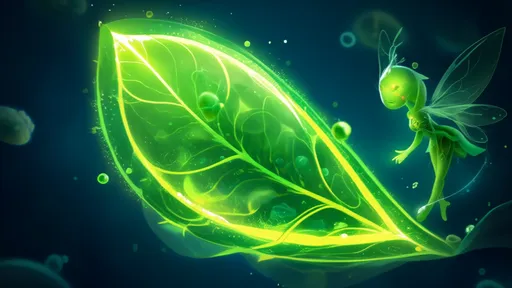
In the emerald corridors of every leaf, chlorophyll molecules await their luminous suitors with the anticipation of star-crossed lovers. These pigment molecules don't merely absorb light; they yearn for specific wavelengths with the selectivity of a poet choosing perfect words. The red and blue regions of the spectrum send their most ardent photons, which chlorophyll embraces while rejecting the indifferent greens - hence the verdant color we perceive as foliage.
What unfolds next resembles a molecular ballet more than a chemical reaction. When a photon strikes a chlorophyll molecule, its energy elevates an electron to an excited state - not unlike the dizzying rush of first love. This excited electron begins a carefully choreographed journey through what scientists prosaically call the electron transport chain, but which might better be described as a quantum courtship ritual. Each handoff of this energized electron extracts a portion of its passion to forge the molecular bonds that will become the plant's sustenance.
The photosynthetic apparatus operates with precision that puts our most advanced technology to shame. Consider that a single chloroplast can perform this light conversion with nearly 100% quantum efficiency - a feat our best solar panels can only dream of matching. This efficiency stems from an exquisite molecular architecture where every component is optimally positioned to receive and process light energy. The proteins holding chlorophyll molecules act as both matchmaker and chaperone, ensuring each photon's energy is properly directed toward productive ends rather than wasteful dissipation.
Water molecules play the unsung heroes in this drama, their bonds broken to provide the electrons needed to keep the photosynthetic conveyor belt moving. The oxygen we breathe is merely the byproduct of water's sacrifice - a molecular exhale from the green world's relentless light-feast. Meanwhile, carbon dioxide molecules arrive like shy suitors at a dance, each one carefully disassembled so its carbon atoms can be incorporated into sugars through the Calvin cycle's meticulous steps.
Modern research reveals photosynthesis as even more remarkable than we once believed. Scientists have discovered that quantum coherence - where molecules exist in multiple states simultaneously - plays a role in the nearly perfect energy transfer within the photosynthetic complex. This means the system leverages the bizarre rules of quantum physics to optimize energy transport, essentially allowing chlorophyll to "try all possible paths" before selecting the most efficient route. Such quantum effects were thought impossible in warm, wet biological environments until their recent detection in photosynthetic organisms.
The evolutionary story of photosynthesis reads like an epic romance spanning geological ages. Cyanobacteria first developed this light-harvesting trick around 3 billion years ago, eventually sharing their photosynthetic genes through the endosymbiotic event that created chloroplasts. This ancient partnership between a primitive cell and a light-capturing bacterium ultimately made complex life possible by oxygenating Earth's atmosphere. Every leaf today carries this ancestral memory in its chloroplasts - organelles that still retain their own bacterial DNA as a testament to their independent origins.
Human attempts to harness photosynthesis' power remain clumsy by comparison. Artificial photosynthesis projects struggle to replicate even a fraction of nature's elegant system. Where plants seamlessly integrate light capture, energy conversion, and chemical synthesis in a self-repairing package, our technologies require rare metals, complex manufacturing, and produce hazardous byproducts. Perhaps we've been approaching the problem backward - rather than building synthetic systems from scratch, we might learn more by listening to the photosynthetic wisdom encoded in every leaf.
As climate change alters our world, understanding photosynthesis becomes more than academic. The same process that built our atmosphere's protective ozone layer now stands as our greatest ally against rising carbon dioxide levels. Forests, phytoplankton, and even humble grasses work tirelessly to mitigate our emissions through their light-driven carbon fixation. Some researchers propose enhancing natural photosynthesis through genetic engineering as a climate solution, while others look to mimic its principles for carbon-negative technologies.
At dawn, when the first photons touch a leaf's surface, a love story older than dinosaurs begins anew. Chlorophyll molecules awaken to their daily dance with sunlight, spinning photons into the sugars that become wood, fruit, and flowers. This silent alchemy sustains nearly every creature on Earth - from hummingbirds to humans - all nourished by light's embrace of a green pigment. The true poetry of photosynthesis lies not in its chemical equations, but in its endless generosity: a billion-year-old gift of sunlight made edible, written in the secret language of chlorophyll.

By /Aug 18, 2025

By /Aug 18, 2025

By /Aug 19, 2025
By /Aug 18, 2025
By /Aug 27, 2025

By /Aug 18, 2025

By /Aug 18, 2025

By /Aug 18, 2025

By /Aug 18, 2025

By /Aug 18, 2025
By /Aug 27, 2025

By /Aug 18, 2025

By /Aug 19, 2025

By /Aug 27, 2025

By /Aug 18, 2025

By /Aug 18, 2025

By /Aug 18, 2025

By /Aug 18, 2025
By /Aug 27, 2025

By /Aug 18, 2025