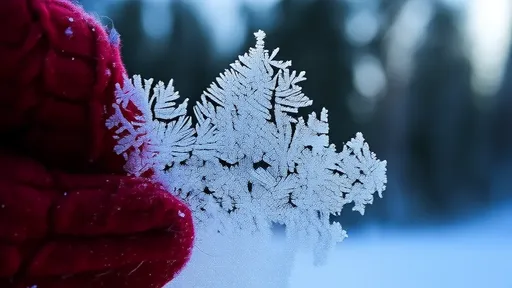
The bitter cold of deep winter brings with it a fleeting artistry that few pause to appreciate. When temperatures plummet below -20°C, an extraordinary phenomenon transforms ordinary windows into galleries of frost masterpieces - delicate ice crystals that bloom across glass surfaces like nature's own stained glass. These "ice window flowers," as they're poetically called in some northern cultures, represent one of winter's most exquisite yet overlooked wonders.
A Microscopic Ballet of Water and Cold
The creation of these crystalline patterns is anything but random. When warm, moist indoor air meets the ultra-cold window surface, water vapor immediately transitions from gas to solid in a process called deposition. Unlike frost that forms on outdoor surfaces, these indoor-grown crystals develop slowly, allowing intricate structures to emerge. The specific patterns depend on microscopic imperfections in the glass, variations in temperature across the pane, and even subtle air currents in the room.
Renowned physicist Kenneth Libbrecht has studied these formations extensively, noting how they mirror the growth patterns seen in snowflakes. "What makes window frost special," he explains, "is that it grows two-dimensionally against the glass surface, creating these spectacular flat projections that we can examine in perfect detail." The most spectacular displays occur when windows are particularly cold while the indoor humidity remains high - conditions common in northern homes during extreme cold spells.
The Ephemeral Gallery
Unlike permanent artwork, these frozen masterpieces exist in constant flux. A crystal flower garden might take hours to develop, reach peak intricacy by dawn, then disappear before noon as sunlight warms the glass. This transience adds to their magic. Photographer Svea Schneider, who has documented window frost across Arctic regions, describes the challenge: "You're racing against the sun, knowing these creations won't survive the day. There's a melancholy beauty in that."
Different climates produce distinct styles of ice flowers. The dry cold of continental interiors tends to create sharper, geometric patterns resembling ferns or feathers. Coastal areas with higher humidity often show softer, more rounded formations. Some particularly spectacular displays feature three-dimensional elements where crystals grow outward from the glass, catching light like tiny chandeliers.
Cultural Ice
Northern peoples have long incorporated these natural designs into their winter traditions. In parts of Russia and Scandinavia, children are taught to "read" frost patterns like nature's storybooks, interpreting shapes as animals, forests, or celestial beings. Japanese Ainu culture considers intricate window frost a sign of a prosperous winter, while some Inuit groups historically used the patterns' thickness to predict coming weather.
The artistic influence extends beyond folklore. Architect Alvar Aalto famously incorporated frost-inspired designs in his glassware, and contemporary artists like Andy Goldsworthy have created installations mimicking these natural formations. "What fascinates me," Goldsworthy notes, "is how the ice makes visible the invisible - the hidden movements of air and moisture we normally never see."
The Science of Splendor
At the molecular level, these creations showcase water's astonishing versatility. As humidity freezes, water molecules arrange themselves into hexagonal lattices - the same basic structure found in snowflakes. But unlike free-falling snow crystals that grow symmetrically in three dimensions, window frost develops asymmetrically as it's constrained by the glass surface.
Materials scientist Professor Maria Jeffries explains: "The initial ice crystals act like seeds. As more vapor freezes onto these nucleation points, the patterns branch outward in fractal growth. Temperature fluctuations cause pauses and resumptions in growth, creating those beautiful layered effects." This stop-start growth explains why the most complex patterns often appear after particularly cold, still nights when conditions remain stable for hours.
Preserving the Impermanent
Modern life has made these winter wonders increasingly rare. Triple-glazed windows and advanced insulation prevent the extreme glass cooling needed for frost formation. In many northern cities, children now grow up never having seen their windows transform into crystal canvases. Some communities have begun intentionally creating "frost gardens" by installing single-paned display windows in public spaces during winter months.
Photographic documentation has become crucial for preserving this vanishing art. The Window Frost Archive, a digital collection started by Norwegian researchers, now contains over 15,000 images showing patterns from across the circumpolar region. Curator Ingrid Dahl notes: "We're not just collecting pretty pictures. These images help track subtle changes in winter conditions and humidity patterns over time."
Creating Your Own Frost Gallery
For those living in cold climates, encouraging frost flowers requires balancing warmth and humidity. Traditional wooden-framed single-pane windows work best. Increasing indoor humidity through cooking or bathing in the evening can help, though experts warn against excessive moisture that could damage homes. The clearest patterns often form on very clean glass, as dirt and grease can disrupt crystal growth.
Photographing these delicate creations presents unique challenges. Macro lenses capture intricate details best, while side lighting emphasizes the three-dimensional qualities. Schneider advises: "Shoot at dawn when the crystals are fully formed but before direct sunlight hits them. Use a tripod and natural light - flash destroys the subtle textures."
A Warming World's Lost Art
As global temperatures rise, the conditions needed for spectacular frost formations become increasingly rare. Researchers at the University of Alaska have documented a 30% decrease in optimal frost-forming days over the past 50 years in some northern locations. What was once a common winter occurrence now requires specific weather patterns - prolonged cold snaps without cloud cover or wind.
This loss extends beyond aesthetics. Frost patterns serve as visible indicators of humidity and temperature gradients that are otherwise invisible. Indigenous hunters traditionally used them to assess ice safety, while farmers interpreted certain formations as predictors of spring thaw timing. Their disappearance represents another severed connection between humans and their environment.
Perhaps there's a lesson in these ephemeral creations - that beauty often lies in transient, unexpected moments. As we rush through winter's darkness, the ice flowers remind us to pause and appreciate nature's quiet artistry. They transform our view of bitter cold from something to endure into something to marvel at, if only we take the time to look.
By /Aug 18, 2025

By /Aug 18, 2025
By /Aug 19, 2025
By /Aug 18, 2025
By /Aug 27, 2025
By /Aug 18, 2025
By /Aug 18, 2025
By /Aug 18, 2025

By /Aug 18, 2025
By /Aug 18, 2025
By /Aug 27, 2025
By /Aug 18, 2025
By /Aug 19, 2025
By /Aug 27, 2025
By /Aug 18, 2025
By /Aug 18, 2025

By /Aug 18, 2025

By /Aug 18, 2025
By /Aug 27, 2025
By /Aug 18, 2025