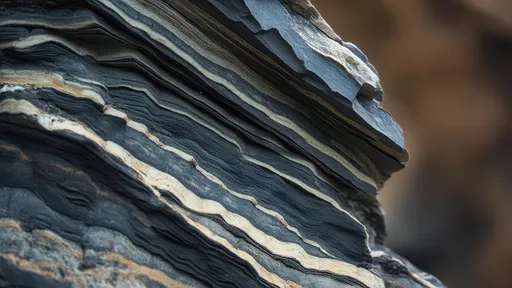
The earth writes its secrets in stone, and nowhere is this more evident than in the delicate foliations of metamorphic rocks. Schistosity—the parallel alignment of mineral grains that gives schist its signature layered appearance—is more than just a geological phenomenon. It is a love letter penned by heat and pressure, a testament to the enduring romance between time and the elements.
To hold a piece of mica schist is to hold a page from the planet's diary. The way light dances across its glittering surface recalls the flicker of candlelight on parchment. These rocks don't merely form; they compose themselves, arranging their mineral constituents into lyrical patterns that would make a poet envious. The biotite flakes might be compared to hastily scribbled notes in the margins, while the quartz veins form the steady rhythm of iambic pentameter beneath.
Field geologists speak of schist in unexpectedly tender terms. There's talk of "rock cleavage" and "preferred orientation," but listen closely and you'll hear the language of intimacy. When a geologist runs weathered fingers along a foliation plane, they're not just measuring strike and dip—they're reading braille love letters from the Paleozoic. The way certain schists split easily along their planes reminds one how vulnerability can be beautiful when arranged just so.
The formation of schist requires just the right combination of circumstances—like any good romance. Parent rocks (the protoliths) must encounter just enough heat to soften their edges but not so much as to erase their character. Directed pressure then coaxes the minerals to align, much as shared experiences might align two lives. Chlorite and muscovite crystals turn perpendicular to the stress, creating that characteristic schistose fabric. What appears as mere structural adjustment is actually mineral grains learning to dance together.
Certain schists develop porphyroblasts—large crystals that grow during metamorphism while the surrounding matrix flows around them. These mineral phenocrysts stand like bold declarations amidst the flowing foliation. A garnet crystal in schist isn't just a mineral inclusion; it's the geological equivalent of writing "I love you" in block letters across a carefully penned sonnet. The contrast makes both elements more meaningful.
The temporal dimension adds profundity to this stony correspondence. Some schist layers represent millions of years of slow metamorphic courtship. The very slowness of the process—the gradual alignment, the patient recrystallization—speaks to a kind of devotion alien to our hurried age. In an era of digital immediacy, these rocks remind us that the most meaningful connections form through sustained pressure over incomprehensible timescales.
Perhaps most remarkably, this mineralogical poetry isn't rare. Schists form much of the basement rock across continents, meaning the Earth has been writing these love letters beneath our feet all along. The next time you hike across rocky terrain, consider that the ground itself may be a anthology of metamorphic verse—each foliation plane a stanza, each mineral band a line in the planet's ongoing lyric to itself.
Mountain building events fold and refold these stony manuscripts, creating complex interference patterns like palimpsests of passion. The wrinkles and contortions in high-grade schists tell of tectonic embraces so powerful they rearrange entire mineralogies. Yet through it all, the essential message remains: persistence transforms, pressure creates beauty, and time writes the most moving compositions of all.
Modern geology often reduces such phenomena to sterile graphs of pressure-temperature conditions. But the human mind instinctively recognizes something more profound in these aligned minerals. We see in schistosity what we hope for in ourselves—the capacity to be reshaped by experience without losing our essence, to become more beautifully ordered through life's pressures. The rocks remind us that transformation, however gradual, can yield exquisite results when we align ourselves with forces greater than our own.
As erosion gradually exposes these metamorphic love letters at the surface, we're granted temporary access to correspondence meant for geological eyes. The schist's foliation represents a moment frozen in stone—a snapshot of minerals caught in the act of becoming. To study such rocks is to eavesdrop on a conversation between the Earth's crust and its mantle, a dialogue written in the only language either has ever known: heat, pressure, and time.

By /Aug 18, 2025

By /Aug 18, 2025

By /Aug 19, 2025

By /Aug 18, 2025

By /Aug 27, 2025
By /Aug 18, 2025

By /Aug 18, 2025

By /Aug 18, 2025

By /Aug 18, 2025
By /Aug 18, 2025
By /Aug 27, 2025

By /Aug 18, 2025
By /Aug 19, 2025

By /Aug 27, 2025

By /Aug 18, 2025
By /Aug 18, 2025
By /Aug 18, 2025

By /Aug 18, 2025

By /Aug 27, 2025

By /Aug 18, 2025